

Wear parts inventory management is the balancing act every plant maintenance manager knows well: hold too much and capital sits idle in the warehouse, hold too little and a shutdown waits on parts. The real question, however, is rarely how much to hold — it is which parts must be stocked, how many, and when to reorder. Without data behind those three decisions, stocking relies on feel, and feel tends to fail on the most expensive item. After 40 years in wear casting since the 1980s, serving clients including CNBM and Conch Cement, the Grand Heavy team sets out the calculation method and grading logic.

图:大美智造耐磨配件实物——八大类配件可按机型与腔型配型,每批随附材质成分单
| Quick View | Verdict |
|---|---|
| Core question | Not how much to hold, but which to stock, how many, when to reorder |
| Most expensive cost | Downtime loss — usually far exceeding inventory capital cost |
| Method | ABC grading plus safety stock formula plus wear log driven |
| Third path | Parts consignment (supplier-managed, settled on usage) |
| Most common error | Reordering by feel without logs, treating critical and consumable parts alike |
Wear parts inventory is hard to manage because three conflicts pull against each other:
Understanding these three conflicts explains why a blanket rule of three months of stock rarely works: different categories differ completely in capital intensity, interchangeability and failure behaviour.
A stone plant we served held large quantities of low-value consumables — screen mesh, bolts and gaskets covering two years of usage across a full row of shelving. Yet the cone crusher bowl liner had only one set in stock, already approaching its change-out cycle.
During a peak season, when the liner came due, the stocked set turned out to be the wrong cavity type for the machine on site (it had been bought for a different unit), and emergency procurement ran into supplier scheduling. The plant ended up waiting more than ten days with the line down. The lost output far exceeded the value of those two years of low-value parts.
The review found a classic cause: inventory had formed around the instinct to stock more of the cheap items and less of the expensive ones, rather than around shutdown impact. The fix had three steps:
After the fix the total inventory value barely changed, yet availability of critical parts improved markedly. The rule recorded: grade by shutdown impact, not by unit price.
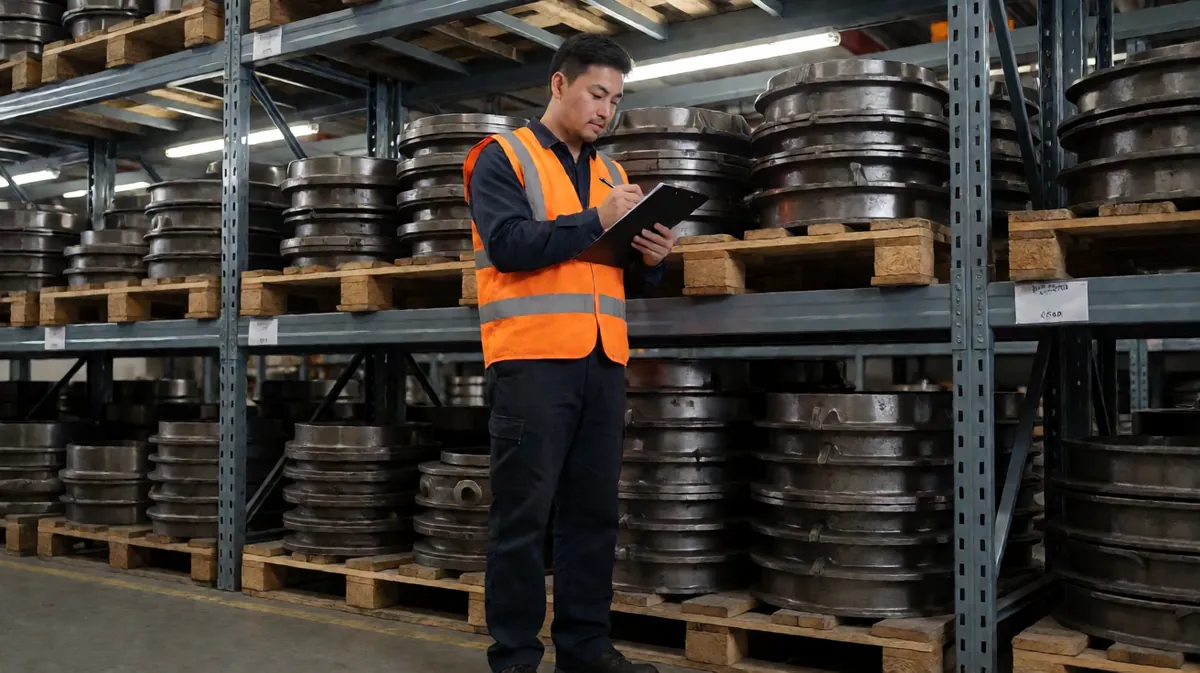
图:耐磨件库存盘点——按停机影响分级、用台账驱动补货
| Class | Typical Parts | Grading Basis | Stocking Policy |
|---|---|---|---|
| A (critical) | Mantles, bowl liners, jaw plates, blow bars, hammer heads | Absence stops production, no substitute | Hold 1-2 sets, reorder ahead via logs |
| B (important) | Roll liners, throwing heads, flow plates, grinding rolls, grinding media | Absence cuts capacity or forces reduced load | Hold one set or stock to consumption rate |
| C (consumable) | Screen mesh, bolts, seals, fasteners | Low value, fast to procure, no immediate stop | Minimise stock, small frequent replenishment |
| Common parts | Standard bolts, gaskets, grease | Shareable across equipment | Pool centrally, manage as a total |
| Dedicated parts | Non-standard liners, custom castings | Fit one model or cavity only | Verify model and cavity to avoid dead stock |
| Sudden failure parts | Main shaft, large gears, critical bolts | Unpredictable, but failure means long downtime | Cover with safety stock or an emergency supply agreement |
Safety stock calculation (general formula):
Safety stock = average daily consumption x replenishment lead time x safety factor
Average daily consumption comes from wear logs; lead time covers supplier scheduling and transport; the safety factor rises with shutdown impact (high for class A, low for class C).
Reorder point = safety stock + normal consumption during lead time. Place the order when stock reaches that point rather than when it nearly runs out. Exact parameters must be calculated from each plant actual consumption and supplier lead times. [To be added: customer spare parts consumption and lead time logs]
| Plant Profile | Recommended Inventory Route |
|---|---|
| Large integrated mine (multi-million tonnes) | Full ABC grading plus log-driven reorder plus consignment; hold 1-2 sets of class A |
| Mid-size aggregate plant | Focus on class A critical parts; B and C replenished on demand; pool common parts |
| Small or short-term line | Keep only minimum class A stock and sign an emergency supply agreement |
The core of wear parts inventory management is not holding more or less but grading by shutdown impact first, then setting reorder points from log data. Moving capital from low-value consumables to class A critical parts keeps the total unchanged while raising availability sharply — that is where the value lies. Foshan Grand Heavy Trading Co., Ltd. has built mining equipment and wear casting expertise for 40+ years, holds 20+ patents, partners with Central South University and Guangdong University of Technology, and is certified as a National High-Tech Enterprise [To be added: certificate number]. We serve CNBM, Conch Cement and clients across 6 overseas markets with 24-hour response from Guangzhou, Foshan and Changsha.
📞 Wear Parts Grading, Matching and Stocking Plans — Grand Heavy
40 Years of Wear Casting | 20+ Patents | CSU and GDUT Partnerships | National High-Tech Enterprise
Trusted by CNBM & Conch Cement | 24-Hour Response from Guangzhou, Foshan, Changsha
Hotline: +86-0757-18144901190 | Email: zhouwenbin@fsgrandheavy.com
Website: www.fsgrandheavy.com
Grand Heavy — Grade by shutdown impact, reorder by log data!

Crusher Wear Parts Life Reference Table: Jaw Plates, Blow Bars, Hammers, Mantles and More

5 Common Cone Crusher Failures and How to Fix Them

Advantages of the Small Hydraulic Double-Roll Sand Making Machine

Jaw Plate Buying Guide: Material Identification, Price Traps and Replacement Cycles

Beyond Material Wear: What Other Factors Shorten the Service Life of Fixed Jaw Plates?

Jaw Crusher vs Impact Crusher: Which One to Choose? A 6-Factor Comparison


Room 3411, Building 1, Xinrui Plaza, No. 10 Lianing Avenue South, Dongping Community, Lecong Town, Shunde District, Foshan City (for office use only)
18144901190 (Miss Zhou )
zhouwenbin@fsgrandheavy.com

I. The information displayed on this website is provided by the website owner, who is responsible for the authenticity, accuracy, and legality of the content.
II. If the certificates displayed on this website are expired or invalid, visitors are welcome to notify us to replace them with valid certificates. (Contact information available on this website)
III. If the information displayed on this website infringes your copyright or other legal rights, or displays any content violating national laws, please contact us (Company: Foshan Damei Smart Manufacturing Trading Co., Ltd Phone: 18144901190 Email: zhouwenbin@fsgrandheavy.com). We will review and handle within 24 hours.
The New Advertising Law stipulates that no absolute or functional terms shall appear on any page. Our company supports the New Advertising Law. In order not to affect consumers' normal purchases, we have reviewed and modified the prominent areas of our pages. We hereby solemnly declare: All absolute and functional terms on our pages are invalid before this declaration and shall not be used as grounds for compensation.
For non-prominent areas and unchecked areas, we will gradually make improvements. However, manual review cannot guarantee 100% completeness. We do not accept or compromise on any form of compensation claims based on superlative terms or online fraud in the name of counterfeit detection. Please make way for genuine consumers, as rights protection is a two-way process. We hope new and old customers understand and support us, and contact customer service to help improve.
Pursuant to the Advertising Law and instructions from the Administration for Industry and Commerce, we specially remind you that the product titles on this website are set purely for operational and technical traffic purposes and do not constitute product efficacy claims. Please do not take them out of context. Additionally, in accordance with Article 15 of the Consumer Rights Protection Law of the People's Republic of China regarding the authenticity of product promotion, as well as the Advertising Law, the Management Standards for Disinfection Product Labels and Instructions, the Regulations on Supervision and Administration of Medical Devices, and other relevant laws and regulations.
All products sold are officially authorized. The actual formula (structure) of the products is consistent with the product packaging or instructions. Page titles are keywords used solely to match buyer search habits and do not represent the actual efficacy and characteristics of the products. The text, images, and video information on the page are solely for website optimization purposes. The actual ingredients and efficacy of the products are subject to the product packaging or instructions. Please be informed!


