

Cone crusher cavity type is the part buyers most often overlook — comparisons usually focus on model, power and price, rarely on which cavity the machine carries. Yet the cavity decides the three things that matter most: whether it can accept your feed, how fine the product can be, and how good the particle shape is. Choose wrongly and the result ranges from falling short of rated capacity to frequent choking and abnormal liner wear. After 40 years in crushing equipment since the 1980s, and with cavity optimization research alongside Central South University, the Grand Heavy team explains the differences and how to choose.

Grand Heavy cone crusher liners — each cavity type needs its own liner profile, with a material certificate per batch
| Quick View | Verdict |
|---|---|
| Three key dimensions | Feed opening, parallel zone, closed side setting |
| Secondary stage | Standard (coarse or medium cavity) — large feed opening |
| Tertiary stage | Short head (fine or extra fine) — long parallel zone, high reduction ratio, better shape |
| Biggest myth | Adjusting only the closed side setting while ignoring the feed opening |
| Hidden variable | Liner wear changes the cavity profile, not just its thickness |
The crushing chamber of a cone crusher is formed by the profiles of the mantle and the bowl liner. Cavity type simply describes the geometry those two liners create. Three dimensions define it:
By geometry, cone crushers fall into three basic types:
Within each type, cavities are further graded as coarse, medium, fine and extra fine to match feed size and target product size. Grand Heavy supplies spring, hydraulic and multi-cylinder hydraulic cone crushers with feed sizes up to roughly 300 mm and capacities of 30-1000 t/h, with cavities configured to duty; cavity optimization is one of our research topics with Central South University. [To be added: cavity optimization field comparison data] Liner material selection is covered in Cone Crusher Liner Materials.
Nearly every cavity problem we see on site falls into one of two categories.
First: a cavity too fine for the secondary stage. One aggregate plant installed a cone with a fine cavity at the secondary stage. Product shape was good initially, but problems emerged: the small feed opening choked frequently when the proportion of large lumps rose, motor current fluctuated and output never reached design. The secondary stage receives relatively large feed, so a fine cavity cannot swallow it and material piles up at the opening instead of entering the chamber.
Second: a standard cavity at the tertiary stage. Another plant kept a standard cavity for tertiary crushing, resulting in coarse product and a clear rise in circulating load — the reduction ratio was insufficient, so material cycled between screen and crusher, consuming capacity while liners wore faster.
Both share one root cause: selection looked only at whether the machine was big enough, not at whether the cavity matched the crushing stage. The fixes are equally clear — the first case needs a cavity with a larger feed opening (standard or coarse), the second needs a longer parallel zone (short head or fine). This became a standard pre-selection step for us: confirm the crushing stage and feed size first, then set the cavity.
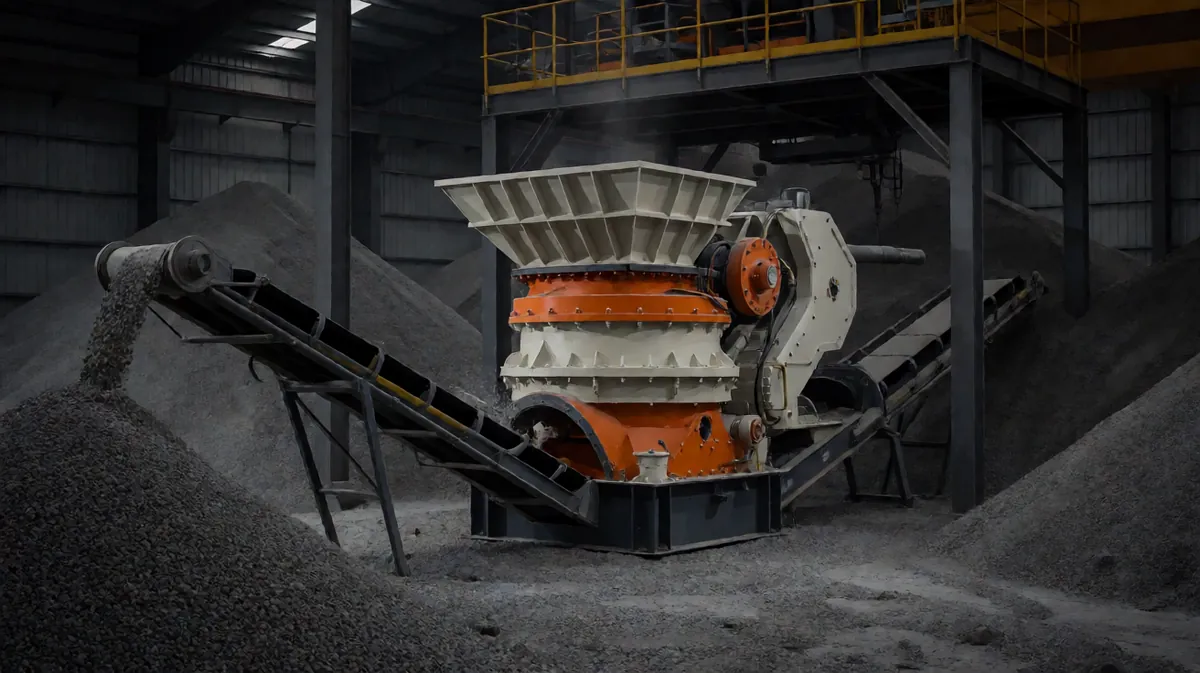
Cone crusher running in a hard rock aggregate plant — cavity type decides feed intake and product shape
| Stage | Recommended | Feed Opening | Parallel Zone | Ratio / Capacity |
|---|---|---|---|---|
| Secondary (large feed) | Standard (coarse) | Large | Short | Medium ratio / high capacity |
| Secondary (finer product) | Standard (medium or fine) | Medium | Medium | Medium-high ratio / medium capacity |
| Transition stage | Medium | Medium | Medium | Medium-high ratio / medium capacity |
| Tertiary (fine, good shape) | Short head (fine) | Small | Long | High ratio / lower capacity |
| Pre-sand tertiary (finest) | Short head (extra fine) | Smallest | Longest | Highest ratio / lowest capacity |
| High proportion of large lumps | Prioritize feed opening | Check against largest lump | — | Better coarse than too fine |
| Persistently high circulating load | Cavity too coarse, go finer | — | Needs lengthening | Reduction ratio insufficient |
Three-step selection: 1. Set the basic type from the crushing stage (secondary equals standard, tertiary equals short head); 2. Check the feed opening against the largest feed lump; 3. Set the CSS and cavity fineness from the target product size. Exact cavity profiles and feed opening dimensions must be checked against the model parameter table. [To be added: cavity parameter table by model]
| Plant Profile | Recommended Cavity Route |
|---|---|
| Two-stage crushing (jaw plus cone) | Cone handles secondary and tertiary; start with standard or medium, then tune the cavity to product |
| Three-stage (jaw plus two cones) | Standard or medium at stage two, short head at stage three — clear cavity division |
| High-grade aggregate, shape critical | Short head fine cavity at the tertiary stage to secure parallel zone length |
Cavity selection comes down to one line: set the type from the crushing stage, the feed opening from the largest lump, and the fineness from the target product. Secondary duty must be able to swallow the feed (standard), tertiary duty must grind it fine (short head) — and when replacing liners, remember that you are replacing a cavity profile, not just thickness. Foshan Grand Heavy Trading Co., Ltd. has built mining equipment and wear casting expertise for 40+ years, holds 20+ patents, partners with Central South University on cavity optimization and Guangdong University of Technology on mill table design, and is certified as a National High-Tech Enterprise [To be added: certificate number]. We serve CNBM, Conch Cement and clients across 6 overseas markets with 24-hour response from Guangzhou, Foshan and Changsha.
📞 Cone Crusher Cavity Selection, Liner Customization & Duty Analysis — Grand Heavy
40 Years of Wear Casting | 20+ Patents | CSU Cavity Optimization Partnership | National High-Tech Enterprise
Trusted by CNBM & Conch Cement | 24-Hour Response from Guangzhou, Foshan, Changsha
Hotline: +86-0757-18144901190 | Email: zhouwenbin@fsgrandheavy.com
Website: www.fsgrandheavy.com
Grand Heavy — Swallow the feed in secondary duty, grind it fine in tertiary duty!

Crusher Wear Parts Life Reference Table: Jaw Plates, Blow Bars, Hammers, Mantles and More

5 Common Cone Crusher Failures and How to Fix Them

Advantages of the Small Hydraulic Double-Roll Sand Making Machine

Jaw Plate Buying Guide: Material Identification, Price Traps and Replacement Cycles

Beyond Material Wear: What Other Factors Shorten the Service Life of Fixed Jaw Plates?

Jaw Crusher vs Impact Crusher: Which One to Choose? A 6-Factor Comparison


Room 3411, Building 1, Xinrui Plaza, No. 10 Lianing Avenue South, Dongping Community, Lecong Town, Shunde District, Foshan City (for office use only)
18144901190 (Miss Zhou )
zhouwenbin@fsgrandheavy.com

I. The information displayed on this website is provided by the website owner, who is responsible for the authenticity, accuracy, and legality of the content.
II. If the certificates displayed on this website are expired or invalid, visitors are welcome to notify us to replace them with valid certificates. (Contact information available on this website)
III. If the information displayed on this website infringes your copyright or other legal rights, or displays any content violating national laws, please contact us (Company: Foshan Damei Smart Manufacturing Trading Co., Ltd Phone: 18144901190 Email: zhouwenbin@fsgrandheavy.com). We will review and handle within 24 hours.
The New Advertising Law stipulates that no absolute or functional terms shall appear on any page. Our company supports the New Advertising Law. In order not to affect consumers' normal purchases, we have reviewed and modified the prominent areas of our pages. We hereby solemnly declare: All absolute and functional terms on our pages are invalid before this declaration and shall not be used as grounds for compensation.
For non-prominent areas and unchecked areas, we will gradually make improvements. However, manual review cannot guarantee 100% completeness. We do not accept or compromise on any form of compensation claims based on superlative terms or online fraud in the name of counterfeit detection. Please make way for genuine consumers, as rights protection is a two-way process. We hope new and old customers understand and support us, and contact customer service to help improve.
Pursuant to the Advertising Law and instructions from the Administration for Industry and Commerce, we specially remind you that the product titles on this website are set purely for operational and technical traffic purposes and do not constitute product efficacy claims. Please do not take them out of context. Additionally, in accordance with Article 15 of the Consumer Rights Protection Law of the People's Republic of China regarding the authenticity of product promotion, as well as the Advertising Law, the Management Standards for Disinfection Product Labels and Instructions, the Regulations on Supervision and Administration of Medical Devices, and other relevant laws and regulations.
All products sold are officially authorized. The actual formula (structure) of the products is consistent with the product packaging or instructions. Page titles are keywords used solely to match buyer search habits and do not represent the actual efficacy and characteristics of the products. The text, images, and video information on the page are solely for website optimization purposes. The actual ingredients and efficacy of the products are subject to the product packaging or instructions. Please be informed!


