

Grinding rods are the only grinding media in a rod mill, and they are what sets it apart from a ball mill. A ball mill uses balls, a rod mill uses rods — and that single difference changes the grinding result, the failure mode and the selection logic entirely. Many plants manage rod mills using ball mill experience and pay heavily for it at the point of rod breakage. After 40 years in mining equipment and wear casting since the 1980s, the Grand Heavy team explains the failure mechanism and selection essentials.

Grand Heavy wear castings — rods, end liners and mill liners share the same 40-year foundry line
| Quick View | Verdict |
|---|---|
| Biggest risk | Not wear, but rod breakage — broken rods tangle, jam the mill and damage liners, with very high clean-out cost |
| Failure mode | Bending then breaking, quite unlike the fracture of grinding balls |
| Core advantage | Line contact grinding gives uniform product size with little over-grinding |
| Selection key | Wear resistance is the baseline; bending and fatigue resistance is the deciding factor |
| Related wear parts | Grinding rods, mill liners, end liners |
Rod and ball mills grind ores and other materials across mining, building materials and chemical industries, in dry or wet mode, with grinding rods, grinding balls and liners as the main wear parts. The essential difference lies in how the media contact each other:
That is why rod mills are chosen where size uniformity matters — preparation ahead of gravity or magnetic separation, processes where over-grinding must be controlled, and specific grinding duties in building materials and chemicals. If the goal is maximum fineness, a ball mill suits better; if the goal is uniform size with minimal over-grinding, the rod mill wins.
A concentrator reported abnormal vibration and fluctuating current on a rod mill. The initial diagnosis was unstable feed, but adjustments brought no improvement. Days later abnormal noise appeared and the mill had to be stopped and opened — several rods had broken, jamming across the shell, tangling with the remaining rods and scoring both the shell liners and the end liners.
Clean-out and replacement cost far more than the rods themselves: several days of downtime, manual clearing, and replacement of liners and end liners. The review found two causes:
The fix came in two steps: switch to rod material with better bending and fatigue resistance, and institute scheduled mill stops with rod inspection and removal — checking straightness each cycle and removing rods beyond limits. Breakage stopped. The rule recorded: rod mill management is less about how much is worn away and more about whether there are bent or disordered rods.
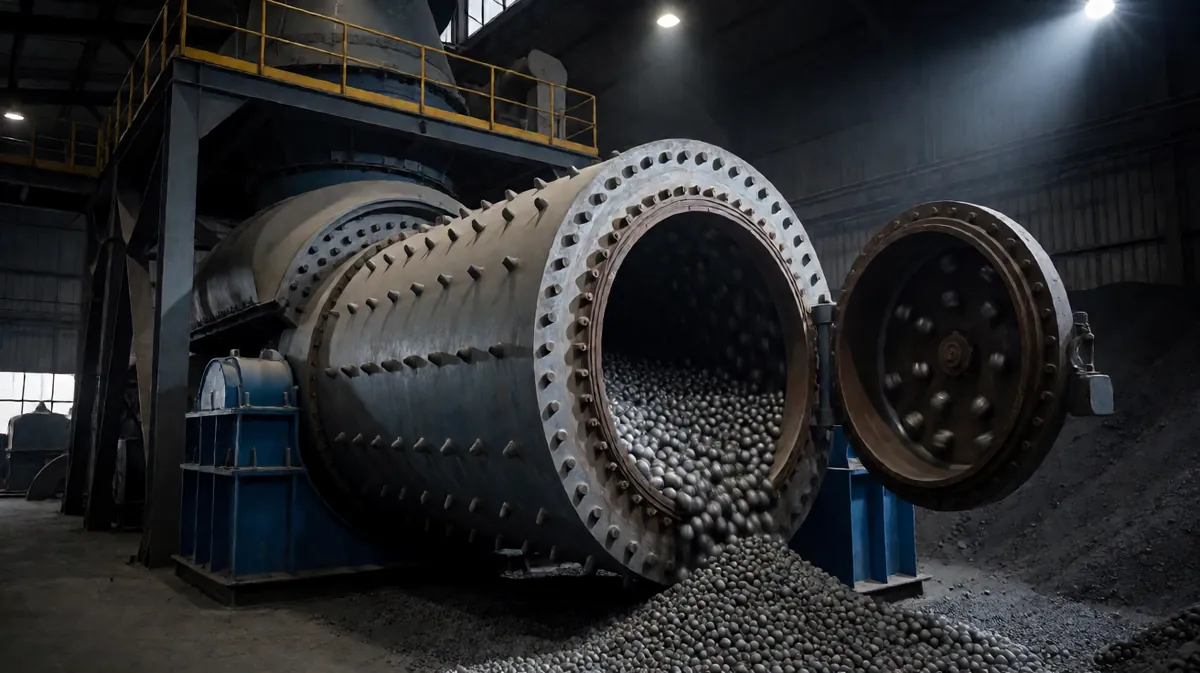
Grand Heavy wear castings — rods and end liners matched to mill specification and duty
| Dimension | What to Check | Recommended | Why |
|---|---|---|---|
| Material | Balance wear and bending resistance | Bending fatigue first | Hard but brittle rods bend first, then break |
| Diameter | Match to feed size | Larger for coarse feed, avoid going oversized | Oversized rods cut efficiency and raise bending risk |
| Length | Must be shorter than effective shell length | Leave end clearance per mill specification | Overlong rods strike and destroy end liners |
| Filling degree | Usually lower than a ball mill | Calibrate to manual and measured output | Excess filling in a rod mill leads to disorder |
| Removal schedule | Is there periodic inspection | Scheduled stops to remove bent rods | Bending precedes breaking and causes disorder |
| Liner matching | Evaluate shell and end liners together | Assess as a set to avoid mismatched wear | Liner wear alters rod motion |
| Acceptance | Bulk purchasing | Certificate plus straightness plus breakage logs | Only these three together reveal value |
Specific diameter mixes, lengths and filling degrees must be calculated from mill specification and feed conditions — follow the mill manual and on-site trials. [To be added: recommended rod diameter and length table] Consumption and breakage rates should be tracked in logs. [To be added: rod consumption logs]
| Buyer Type | Action |
|---|---|
| Budget limited | Protect bending performance; spend effort on removal discipline and liner checks |
| Life focused | Choose material with strong bending fatigue resistance; track breakage and consumption by batch |
| Corporate bulk | Lock diameter, length and material by mill model, require certificates and straightness, annual pricing |
Rod mill selection comes down to one line: the fear is not wear but breakage, and preventing breakage depends not on hardness but on bending fatigue resistance and removal discipline. Choose material with proper bending performance, keep inspecting and removing bent rods, and the rod mill delivers its promised uniform size with minimal over-grinding. Foshan Grand Heavy Trading Co., Ltd. has built mining equipment and wear casting expertise for 40+ years, holds 20+ patents, partners with Central South University and Guangdong University of Technology, and is certified as a National High-Tech Enterprise [To be added: certificate number]. We serve CNBM, Conch Cement and clients across 6 overseas markets with 24-hour response from Guangzhou, Foshan and Changsha.
📞 Rod Mill Rod Selection & Grinding Accessories — Grand Heavy
40 Years of Wear Casting | 20+ Patents | CSU and GDUT Partnerships | National High-Tech Enterprise
Trusted by CNBM & Conch Cement | 24-Hour Response from Guangzhou, Foshan, Changsha
Hotline: +86-0757-18144901190 | Email: zhouwenbin@fsgrandheavy.com
Website: www.fsgrandheavy.com
Grand Heavy — Bending resistance and removal discipline keep rod mills running!

Crusher Wear Parts Life Reference Table: Jaw Plates, Blow Bars, Hammers, Mantles and More

5 Common Cone Crusher Failures and How to Fix Them

Advantages of the Small Hydraulic Double-Roll Sand Making Machine

Jaw Plate Buying Guide: Material Identification, Price Traps and Replacement Cycles

Beyond Material Wear: What Other Factors Shorten the Service Life of Fixed Jaw Plates?

Jaw Crusher vs Impact Crusher: Which One to Choose? A 6-Factor Comparison


Room 3411, Building 1, Xinrui Plaza, No. 10 Lianing Avenue South, Dongping Community, Lecong Town, Shunde District, Foshan City (for office use only)
18144901190 (Miss Zhou )
zhouwenbin@fsgrandheavy.com

I. The information displayed on this website is provided by the website owner, who is responsible for the authenticity, accuracy, and legality of the content.
II. If the certificates displayed on this website are expired or invalid, visitors are welcome to notify us to replace them with valid certificates. (Contact information available on this website)
III. If the information displayed on this website infringes your copyright or other legal rights, or displays any content violating national laws, please contact us (Company: Foshan Damei Smart Manufacturing Trading Co., Ltd Phone: 18144901190 Email: zhouwenbin@fsgrandheavy.com). We will review and handle within 24 hours.
The New Advertising Law stipulates that no absolute or functional terms shall appear on any page. Our company supports the New Advertising Law. In order not to affect consumers' normal purchases, we have reviewed and modified the prominent areas of our pages. We hereby solemnly declare: All absolute and functional terms on our pages are invalid before this declaration and shall not be used as grounds for compensation.
For non-prominent areas and unchecked areas, we will gradually make improvements. However, manual review cannot guarantee 100% completeness. We do not accept or compromise on any form of compensation claims based on superlative terms or online fraud in the name of counterfeit detection. Please make way for genuine consumers, as rights protection is a two-way process. We hope new and old customers understand and support us, and contact customer service to help improve.
Pursuant to the Advertising Law and instructions from the Administration for Industry and Commerce, we specially remind you that the product titles on this website are set purely for operational and technical traffic purposes and do not constitute product efficacy claims. Please do not take them out of context. Additionally, in accordance with Article 15 of the Consumer Rights Protection Law of the People's Republic of China regarding the authenticity of product promotion, as well as the Advertising Law, the Management Standards for Disinfection Product Labels and Instructions, the Regulations on Supervision and Administration of Medical Devices, and other relevant laws and regulations.
All products sold are officially authorized. The actual formula (structure) of the products is consistent with the product packaging or instructions. Page titles are keywords used solely to match buyer search habits and do not represent the actual efficacy and characteristics of the products. The text, images, and video information on the page are solely for website optimization purposes. The actual ingredients and efficacy of the products are subject to the product packaging or instructions. Please be informed!


