

Ball mills, rod mills and vertical roller mills are the three main machines in industrial grinding, yet they work on completely different principles — ball mills rely on point contact impact, rod mills on line contact attrition, and vertical mills on material bed compression. Those differences drive product size characteristics, energy consumption, suitable materials and capital intensity. Choosing wrongly is not a matter of spending a little more — it means product size failing specification or energy cost staying permanently high. After 40 years in mining equipment and wear casting since the 1980s, the Grand Heavy team sets out the boundaries with a decision table.

Grand Heavy wear castings — mill liners, grinding balls, rods and rolls share the same 40-year foundry line
| Quick View | Verdict |
|---|---|
| First question | Not energy comparison, but the product size requirement |
| Uniform size, little over-grinding | Rod mill (line contact) |
| Versatility and large throughput | Ball mill (mature, highly adaptable) |
| Low energy, drying and high capacity | Vertical mill (30 to 50 percent less energy than a ball mill) |
| Key caution | The vertical mill energy advantage is not unconditional — it is more sensitive to moisture and abrasiveness |
Selection starts with understanding how each machine reduces particle size:
Grand Heavy supplies ball mills in grate, overflow and air-swept types with dual slide shoe bearings for smoother running, and LM series vertical mills covering 10 to 200 t/h with the table structure optimized together with Guangdong University of Technology. Liners, grinding balls, rods and rolls are all matched to duty.
We encountered a non-metallic mineral processing plant that, when planning a new grinding line, simply copied a neighbouring operation and installed a ball mill. After commissioning, the result was a wide particle size distribution with an excessive fines fraction, while the downstream process — preparation ahead of gravity separation — specifically required uniform size. The over-ground fines were hard to recover downstream and consumed extra grinding energy.
The review found the root cause: the size requirement was never defined before selection. The neighbour ran different ore and a different downstream process, so copying the equipment model meant copying a mismatched solution. The plant later improved the size distribution by adjusting internal configuration and media, but travelled a long detour to get there.
The rule recorded: the first question in mill selection is neither what the neighbour uses nor which saves power, but what product size the process requires. Uniformity points to a rod mill; extreme fineness points to a ball mill or vertical mill; only then compare energy and capital cost.
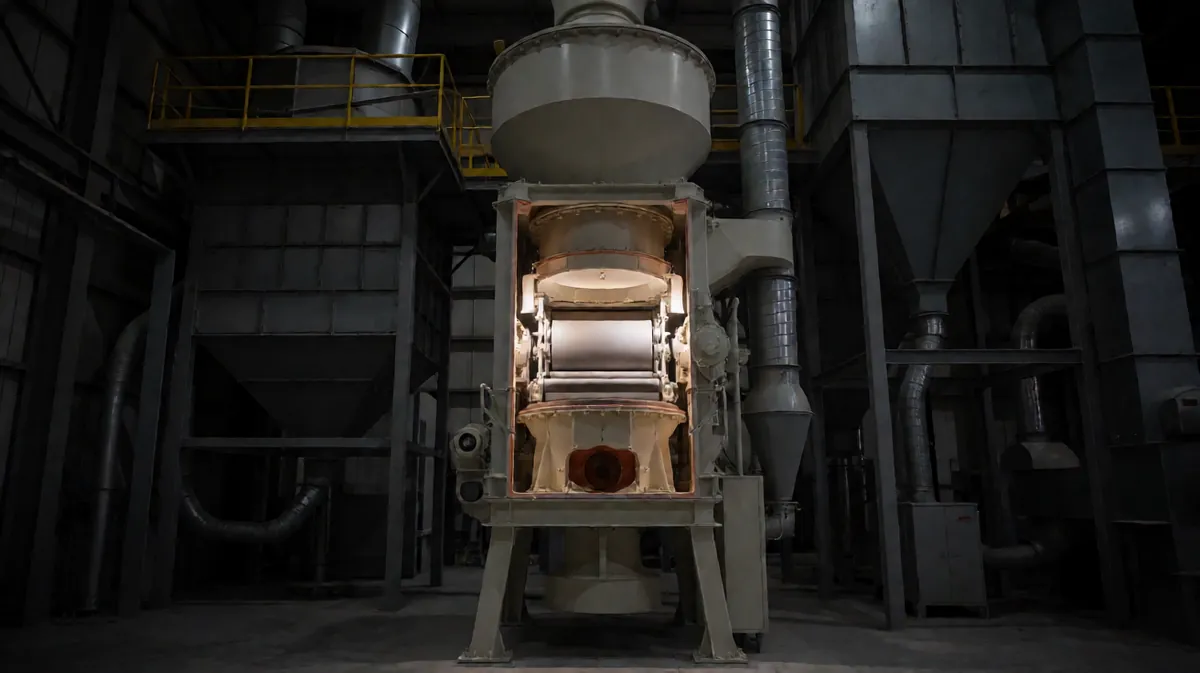
Grand Heavy wear castings — wear parts for all three mill types matched to duty
| Dimension | Ball Mill | Rod Mill | Vertical Mill |
|---|---|---|---|
| Principle | Point contact impact and attrition | Line contact attrition | Material bed compression |
| Product size | High fineness, prone to over-grinding | Uniform, little over-grinding | Adjustable fineness, efficient classification |
| Energy use | Relatively high | Moderate | Low (30 to 50 percent saving) |
| Adaptability and capacity | Mature, highly adaptable, large throughput | Lower capacity | Large capacity (10 to 200 t/h) |
| Feed moisture | Wet or dry | Wet or dry | Strong drying capability (waste heat usable) |
| Abrasive material | Highly tolerant | Highly tolerant | Sensitive (roll wear) |
| Typical use | Concentrator grinding, cement, slag | Pre-gravity or pre-magnetic preparation | Cement raw meal, slag, coal powder |
| Main wear parts | Liners, balls, end liners | Rods, liners, end liners | Grinding rolls, table liners |
Four-step selection: 1. Define the product size requirement (uniformity versus fineness); 2. Check material properties (moisture, abrasiveness, hardness); 3. Confirm capacity and site conditions; 4. Finally compare capital and operating cost. Exact specifications require material test data and capacity targets. [To be added: mill selection material test data]
| Project Profile | Recommended Route |
|---|---|
| Concentrator grinding, varied materials | Ball mill (adaptable, large throughput) |
| Preparation for gravity or magnetic separation | Rod mill (line contact, little over-grinding) |
| Cement raw meal, slag or coal, large capacity | Vertical mill (energy saving, strong drying, high capacity) |
Selection comes down to one line: set direction from the product size requirement, choose the machine from material properties, and settle the plan on total cost. Uniformity points to a rod mill, versatility to a ball mill, low energy with high capacity to a vertical mill — and every one of those must be verified against your own material data rather than a neighbour configuration. Foshan Grand Heavy Trading Co., Ltd. has built mining equipment and wear casting expertise for 40+ years, holds 20+ patents, partners with Central South University and Guangdong University of Technology, and is certified as a National High-Tech Enterprise [To be added: certificate number]. We serve CNBM, Conch Cement and clients across 6 overseas markets with 24-hour response from Guangzhou, Foshan and Changsha.
📞 Mill Selection, Material Testing & Wear Part Matching — Grand Heavy
40 Years of Wear Casting | 20+ Patents | CSU and GDUT Partnerships | National High-Tech Enterprise
Trusted by CNBM & Conch Cement | 24-Hour Response from Guangzhou, Foshan, Changsha
Hotline: +86-0757-18144901190 | Email: zhouwenbin@fsgrandheavy.com
Website: www.fsgrandheavy.com
Grand Heavy — Size sets direction, material sets the machine, data settles the plan!

Crusher Wear Parts Life Reference Table: Jaw Plates, Blow Bars, Hammers, Mantles and More

5 Common Cone Crusher Failures and How to Fix Them

Advantages of the Small Hydraulic Double-Roll Sand Making Machine

Jaw Plate Buying Guide: Material Identification, Price Traps and Replacement Cycles

Beyond Material Wear: What Other Factors Shorten the Service Life of Fixed Jaw Plates?

Jaw Crusher vs Impact Crusher: Which One to Choose? A 6-Factor Comparison


Room 3411, Building 1, Xinrui Plaza, No. 10 Lianing Avenue South, Dongping Community, Lecong Town, Shunde District, Foshan City (for office use only)
18144901190 (Miss Zhou )
zhouwenbin@fsgrandheavy.com

I. The information displayed on this website is provided by the website owner, who is responsible for the authenticity, accuracy, and legality of the content.
II. If the certificates displayed on this website are expired or invalid, visitors are welcome to notify us to replace them with valid certificates. (Contact information available on this website)
III. If the information displayed on this website infringes your copyright or other legal rights, or displays any content violating national laws, please contact us (Company: Foshan Damei Smart Manufacturing Trading Co., Ltd Phone: 18144901190 Email: zhouwenbin@fsgrandheavy.com). We will review and handle within 24 hours.
The New Advertising Law stipulates that no absolute or functional terms shall appear on any page. Our company supports the New Advertising Law. In order not to affect consumers' normal purchases, we have reviewed and modified the prominent areas of our pages. We hereby solemnly declare: All absolute and functional terms on our pages are invalid before this declaration and shall not be used as grounds for compensation.
For non-prominent areas and unchecked areas, we will gradually make improvements. However, manual review cannot guarantee 100% completeness. We do not accept or compromise on any form of compensation claims based on superlative terms or online fraud in the name of counterfeit detection. Please make way for genuine consumers, as rights protection is a two-way process. We hope new and old customers understand and support us, and contact customer service to help improve.
Pursuant to the Advertising Law and instructions from the Administration for Industry and Commerce, we specially remind you that the product titles on this website are set purely for operational and technical traffic purposes and do not constitute product efficacy claims. Please do not take them out of context. Additionally, in accordance with Article 15 of the Consumer Rights Protection Law of the People's Republic of China regarding the authenticity of product promotion, as well as the Advertising Law, the Management Standards for Disinfection Product Labels and Instructions, the Regulations on Supervision and Administration of Medical Devices, and other relevant laws and regulations.
All products sold are officially authorized. The actual formula (structure) of the products is consistent with the product packaging or instructions. Page titles are keywords used solely to match buyer search habits and do not represent the actual efficacy and characteristics of the products. The text, images, and video information on the page are solely for website optimization purposes. The actual ingredients and efficacy of the products are subject to the product packaging or instructions. Please be informed!


