


Wear Parts Purchase Guide: 9 Checks From Material Certificate to Receipt Inspection
The worst outcome when buying wear parts is not paying too much — it is discovering the problem only after installation: manganese content below spec, hidden casting defects behind the backing face, bolt pocket angles that do not match. None of this shows up on delivery day, yet all of it surfaces within weeks in service. After 40 years in wear casting since the 1980s, the Grand Heavy team breaks the purchase process into 9 mandatory checks — what to verify, how to verify it, and what happens if you skip it.

Grand Heavy manganese steel castings — a material certificate ships with every batch for verifiable receipt
| Quick View | Verdict |
|---|---|
| Most common traps | Fake or missing certificates, no heat treatment records, thin wear sections |
| Most overlooked | Bolt pocket fit, microstructure, batch traceability |
| Golden order | Documents first, geometry second, material testing third, service trial last |
| One-line rule | If it cannot be traced, do not order it, however cheap |
I. Why Wear Parts Demand Stricter Inspection
The failure mode defines the inspection logic. Structural parts fail by deformation or fracture — visible and judgeable. Wear parts fail by abnormal wear rate: after one month a good plate has lost 3 mm and a poor one 12 mm. That gap is invisible on delivery day and only emerges after a full service cycle. Worse, the quality differences hide where you cannot see them:
- Heat treatment: Chemically compliant manganese steel with inadequate water toughening loses toughness sharply — while hardness readings may even look better;
- Internal casting defects: Shrinkage, slag inclusions and porosity sit inside the casting with no external sign, cracking under impact once installed;
- Effective wall thickness: External dimensions follow the drawing while the wear working layer is thinner, cutting service life directly.
So the core logic is: convert invisible quality into visible evidence — traceable documents, measurable geometry, re-testable material reports.
II. A Field Lesson: Compliant Chemistry, Cracked In Service
We handled a typical procurement dispute: a quarry bought manganese jaw plates from a trader. On arrival the chemistry certificate was complete with C and Mn inside the specified ranges, at roughly twenty percent below foundry pricing. Within three weeks of installation the tooth peaks developed patchy chipping — brittle cracking, not normal wear.
Sectioning a failed plate revealed a grain boundary carbide network, meaning the water toughening had not been performed properly. The procurement file contained only a chemistry certificate, with no heat treatment records and no mechanical property report. The trader explained that the foundry only issues chemistry sheets — which is precisely the blind spot: treating compliant chemistry as compliant quality.
The dispute ended in a return, but the quarry still absorbed three weeks of downtime plus dismantling and installation labor. One request for a heat treatment record at receipt would have kept that shipment out of the warehouse.
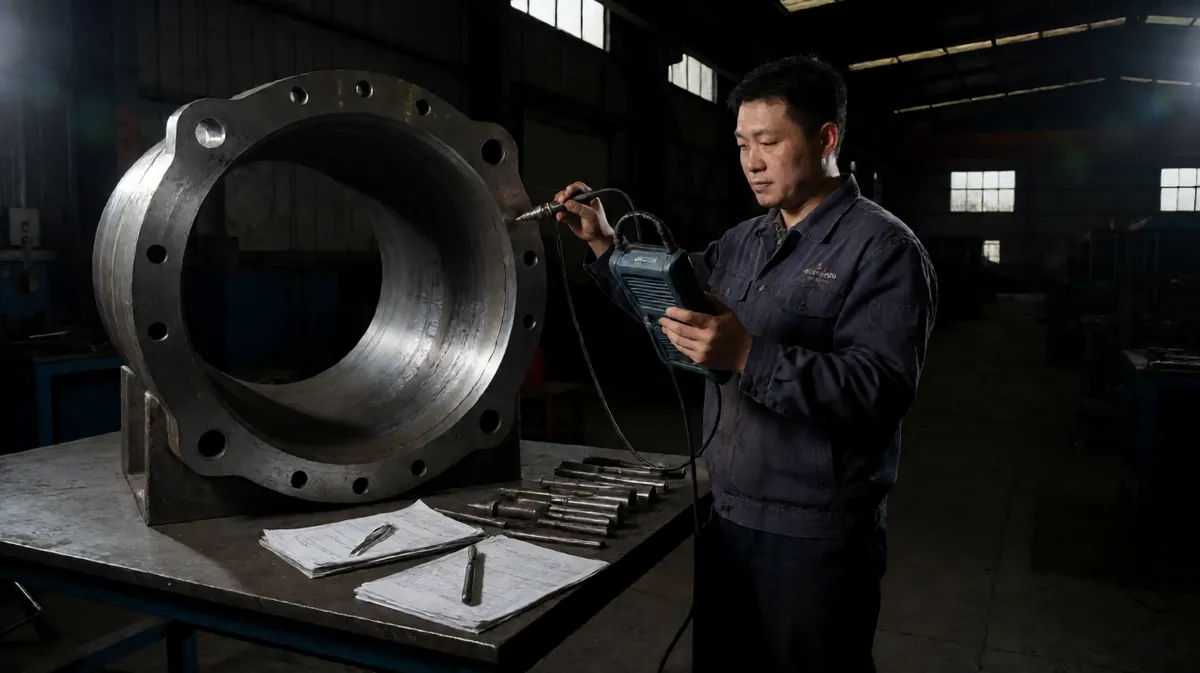
Grand Heavy wear castings — material certificates and process records are archived together for batch traceability
III. The 9 Mandatory Receipt Checks (Save and Print This)
| # | Check | What and How | Cost of Skipping |
|---|---|---|---|
| 1 | Chemistry certificate | Verify C, Mn, Cr ranges; confirm it is batch specific, not a generic template | Insufficient alloy content destroys work hardening and doubles wear rate |
| 2 | Heat treatment record | Request heating temperature, holding time, quench entry temperature and cooling curve | Incomplete toughening precipitates grain boundary carbides and causes chipping |
| 3 | Mechanical report | Focus on tensile strength, elongation and impact energy (toughness metrics) | Low toughness shows up as brittle cracking in the chamber |
| 4 | Microstructure | Sample and section it: single austenite matrix, no grain boundary carbide network | The only check that directly exposes heat treatment quality |
| 5 | Effective wall thickness | Measure the wear layer with calipers or an ultrasonic gauge against drawing tolerance | Ten percent thinner section means directly reduced service life |
| 6 | Nondestructive testing | Magnetic particle or ultrasonic inspection of critical zones for shrinkage, slag, cracks | Internal defects become fracture origins under impact |
| 7 | Geometry and pocket fit | Check hole positions and bolt pocket taper against bolt head taper | Point contact concentrates stress and fatigues bolts |
| 8 | Batch traceability | Confirm a unique batch number traceable to melting and heat treatment records | No accountability and no way to isolate single-part versus batch issues |
| 9 | First cycle validation | Log install date, duty and wear pattern, then review after one full cycle | Without logs there is no trend and the same mistake repeats |
Note: specific acceptance limits and testing methods for each item should follow the current standard text and the agreed technical protocol. [To be added: standard clause and NDT acceptance level references]
IV. Insider Gotchas
- One generic certificate for every batch: A photocopied template sent to all customers — insist on a batch number matched to the actual goods;
- Hardness presented as total quality: Hardness alone without impact toughness. For manganese steel, high as-delivered hardness can actually signal incomplete toughening;
- Verbal NDT promises without reports: Claiming routine inspection while producing no records or acceptance levels — NDT without documentation is NDT not done;
- Suspiciously low pricing: What gets cut is holding time, inspection steps or wall thickness — not margin.
V. When This Checklist Can Be Relaxed
- Low-abrasion consumable parts: In soft rock plants the full test suite can cost more than the part — reduce to chemistry plus visual and dimensional checks;
- Small trial orders: For a first order validating supply capability, start with chemistry and geometry, then expand once stable;
- Long-established suppliers with clean records: Continuous batch performance allows sampling rather than full inspection;
- Non load-bearing components: Guide plates and guards do not require NDT or metallography.
| Scenario | Inspection Depth |
|---|---|
| Critical parts in hard rock duty (jaws, mantles, bowl liners) | All 9 checks; NDT and metallography are not optional |
| Standard parts in moderate abrasion | Chemistry, heat treatment record and geometry as the core three |
| Low abrasion consumables or non load-bearing parts | Chemistry plus visual and dimensional sampling |
FAQ
- Q: Can a chemistry certificate be faked? A: Yes, especially template photocopies. Require batch numbers matched to goods, send samples to a third party when needed, or ask for melting furnace records.
- Q: Is NDT mandatory? A: For critical load-bearing parts in hard rock duty we recommend making it mandatory. Shrinkage and slag inclusions are invisible externally yet become fracture origins under impact.
- Q: What if we lack metallography capability? A: Ask the supplier for a third party metallographic report, or sample-test once on the first order to establish a baseline, then inspect by batch sampling.
- Q: How do we measure effective wall thickness quickly? A: Calipers work for accessible zones; an ultrasonic gauge handles installed or awkward locations. Write the minimum thickness and tolerance into the technical protocol.
- Q: What documents does Grand Heavy provide? A: Grand Heavy wear parts ship with a material certificate per batch, retain heat treatment process records, and support sample-based acceptance and re-testing; NDT and metallography sampling can be agreed contractually.
VI. Final Verdict
Wear parts procurement is not about haggling price but about moving quality risk forward into the receipt inspection: chemistry defines the starting point, heat treatment records and microstructure reveal the process, NDT exposes the interior, and measured wall thickness sets the life floor. Every check performed removes one problem you would otherwise discover only after installation. Foshan Grand Heavy Trading Co., Ltd. has specialized in wear casting for 40+ years, holds 20+ patents, partners with Central South University and Guangdong University of Technology, and is certified as a National High-Tech Enterprise [To be added: certificate number]. We serve CNBM, Conch Cement and clients across 6 overseas markets with 24-hour response from Guangzhou, Foshan and Changsha.
📞 Wear Parts Procurement Support, Documentation & Custom Casting — Grand Heavy
40 Years of Wear Casting | 20+ Patents | Central South University Partnership | National High-Tech Enterprise
Trusted by CNBM & Conch Cement | 24-Hour Response from Guangzhou, Foshan, Changsha
Hotline: +8613762827108 | Email: fsgrandheavy@030340.xyz
Website: www.fsgrandheavy.com
Grand Heavy — A material certificate with every batch, verifiable at receipt!
Popular News

Crusher Wear Parts Life Reference Table: Jaw Plates, Blow Bars, Hammers, Mantles and More

Advantages of the Small Hydraulic Double-Roll Sand Making Machine

Jaw Plate Buying Guide: Material Identification, Price Traps and Replacement Cycles

5 Common Cone Crusher Failures and How to Fix Them

How to Choose Bowl Liner and Mantle Material? Mn13 vs Mn18Cr2 vs Mn22CrMo Compared

Jaw Crusher vs Impact Crusher: Which One to Choose? A 6-Factor Comparison


Room 3411, Building 1, Xinrui Plaza, No. 10 Lianing Avenue South, Dongping Community, Lecong Town, Shunde District, Foshan City (for office use only)
13762827108 (Miss Zhu)
fsgrandheavy@030340.xyz

Disclaimer
Disclaimer
I. The information displayed on this website is provided by the website owner, who is responsible for the authenticity, accuracy, and legality of the content.
II. If the certificates displayed on this website are expired or invalid, visitors are welcome to notify us to replace them with valid certificates. (Contact information available on this website)
III. If the information displayed on this website infringes your copyright or other legal rights, or displays any content violating national laws, please contact us (Company: Foshan Damei Smart Manufacturing Trading Co., Ltd Phone: 13762827108 Email: fsgrandheavy@030340.xyz). We will review and handle within 24 hours.
Declaration of Invalidity of Superlative, Absolute and Functional Terms
The New Advertising Law stipulates that no absolute or functional terms shall appear on any page. Our company supports the New Advertising Law. In order not to affect consumers' normal purchases, we have reviewed and modified the prominent areas of our pages. We hereby solemnly declare: All absolute and functional terms on our pages are invalid before this declaration and shall not be used as grounds for compensation.
For non-prominent areas and unchecked areas, we will gradually make improvements. However, manual review cannot guarantee 100% completeness. We do not accept or compromise on any form of compensation claims based on superlative terms or online fraud in the name of counterfeit detection. Please make way for genuine consumers, as rights protection is a two-way process. We hope new and old customers understand and support us, and contact customer service to help improve.
Legal Notice
Pursuant to the Advertising Law and instructions from the Administration for Industry and Commerce, we specially remind you that the product titles on this website are set purely for operational and technical traffic purposes and do not constitute product efficacy claims. Please do not take them out of context. Additionally, in accordance with Article 15 of the Consumer Rights Protection Law of the People's Republic of China regarding the authenticity of product promotion, as well as the Advertising Law, the Management Standards for Disinfection Product Labels and Instructions, the Regulations on Supervision and Administration of Medical Devices, and other relevant laws and regulations.
Our Commitment
All products sold are officially authorized. The actual formula (structure) of the products is consistent with the product packaging or instructions. Page titles are keywords used solely to match buyer search habits and do not represent the actual efficacy and characteristics of the products. The text, images, and video information on the page are solely for website optimization purposes. The actual ingredients and efficacy of the products are subject to the product packaging or instructions. Please be informed!
- Menu