


How to Accept a Crushing & Screening Plant: No-Load and Loaded Commissioning Checklist
We have manufactured wear parts for more than a decade, and half of our liners are installed during the commissioning stage of new plants — which means we have also watched many owners take silent losses at the acceptance step: nobody logs the motor current during trial runs, so when output falls short three months later, responsibility is impossible to prove; a no-load run of just two hours gets signed off, and a half-loose anchor bolt is only found after the real load goes on. This article shares the full checklist we use when supporting customers at plant commissioning: what to watch, record and gate at each stage — no-load, loaded and with-material trials.
1. The Verdict First: Acceptance Is About Three Ledgers
Many owners treat acceptance as a ceremony — the equipment turns, dust is low, material comes out, signatures follow. A professional acceptance verifies three ledgers: performance (capacity, product shape and energy use versus contract values), quality (installation precision, welding, fit clearances) and documentation (factory inspection certificates, material composition sheets, foundation settlement records). If any ledger has missing pages, later output disputes and wear-part claims have no evidence to stand on.
| Quick view | Summary |
|---|---|
| Applies to | New crushing-screening plants, restarts after retrofit, EPC handover |
| Not for | Simple test runs after single-machine repair (flow can shrink; the ledgers cannot) |
| Deliverables | 3-stage trial procedure + 8-item acceptance checklist + no-load/loaded criteria table |
| One-line advice | Run the with-material trial for at least 72 hours and log data every 2 hours — the only iron rule |
2. No-Load Trial: Listen, Feel the Heat, Watch the Current
The no-load run is a health check for both machine and installation: run continuously for at least 4 hours (8 hours for large cone crushers) and capture three signals.
1. Current curve. Put a recorder on the main-drive ammeter; no-load current should hold at 30%–45% of rated. A sawtooth curve usually means tramp iron left in the feed chute. On a granite plant in northern Guangdong in 2024, unstable no-load current turned out to be an excavator tooth left inside the feeder.
2. Bearing temperature rise. Measure bearing housings every 30 minutes: for rolling bearings the temperature rise must stay below 35℃ with a peak under 70℃ (sliding bearings: rise below 25℃). A curve that climbs and then flattens is normal run-in; one side climbing nonstop means stop immediately — suspect assembly clearance or lubrication.
3. Sound and vibration. A healthy no-load run is an even rustling; metallic knocking points to foreign objects or loose liner bolts. For vibration, stand by the frame: a slight even tingle underfoot is fine, clear resonance means re-check anchor-bolt torque and damping blocks.
3. Loaded Trial: Half Load First, Then Full, Watch Both Ends
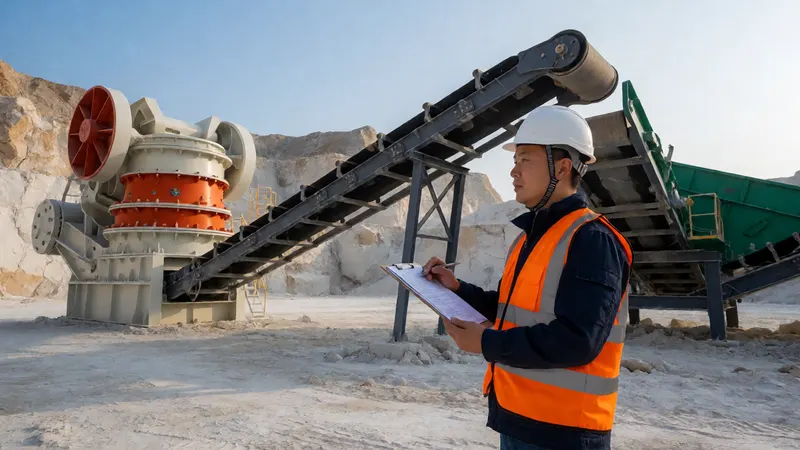
Loaded commissioning runs in two steps: 4 hours at 50% feed, then step up to full load and keep the with-material run going for at least 72 hours. Watch the inlet and the outlet:
- Feed end: material must land centered. Off-center feeding causes one-sided liner wear — the No.1 reason liners deliver only half their expected life. If distribution looks segregated, reposition the feeder.
- Discharge end: take a gradation sample every 2 hours. The curve should match the process design; abnormal fines usually mean a torn screen panel or liners wearing too fast.
- Parameters: current, output (belt scale), discharge opening (hydraulic reading) and bearing temperatures every 2 hours — the 72-hour log is the core attachment of the acceptance report.
4. A Signature We Almost Signed
In 2025 we supported final acceptance on a 300 t/h limestone plant in Guangxi. Everything looked fine for 70 hours; in hour 71 the belt scale slipped quietly from 300 t/h to 285 t/h — small enough for the duty operator to ignore. Cross-checking the log, the screen's current had dropped 6% at the same time: partial blinding of the screen panels by wet fines (rainy-season feed moisture). Had we signed that day, the owner would have spent three months arguing with the EPC contractor about "capacity shortfall". The value of an acceptance log lives in exactly those last two hours of data.
5. The 8-Item Acceptance Checklist (print-ready)
| Item | Typical acceptance criterion | Evidence |
|---|---|---|
| 1. Capacity | 72h average ≥ 95% of contract value | Belt-scale log |
| 2. Particle shape | Flakiness ≤ 15% (GB/T 14685 Class II) `[pending: standard year]` | Sieve analysis |
| 3. Specific energy | ≤ 2.0 kWh/t for a two-stage limestone line | Power meter + output |
| 4. Bearing temperature | ≤ 70℃, rise ≤ 35℃ (rolling bearings) | Inspection sheet |
| 5. Noise | ≤ 85 dB(A) at operator position | Sound-level record |
| 6. Liner installation | Torque verified, backing compound full, no knocking | Installation record + material sheet |
| 7. Safety devices | E-stops, guards and interlocked access doors all functional | Interlock test log |
| 8. Documentation | Material sheets, factory certificates, settlement records complete | Document list |
6. Three Traps Only Insiders Know
Trap 1: accepting on a smooth no-load run. 80% of liner, screen and belt problems only appear under load; no amount of empty running reveals capacity or particle shape.
Trap 2: jumping to full capacity right after acceptance. New liners need a 3–5 day run-in at about 80% load to build their initial work-hardened layer. Straight to full load chips and spalls the edges — we have seen plenty of those fragments in our lab.
Trap 3: no paperwork for the wear parts. At acceptance, cross-check the material composition sheet of every wear-part batch. Every batch we ship carries a composition sheet and supports sample-based re-verification; liners are water-toughened at about 1050℃ per GB/T 5680 `pending: standard year`. Without that page, an early liner failure three months later leaves you without even a counterparty to claim against.
7. Limitations
The cost of this procedure is time and labor: a 72-hour with-material trial means an extra week of commissioning fees and power. Small plants (below 500 t/d) can compress it to 48 hours, but none of the three ledgers should be dropped. This checklist is calibrated for aggregate/limestone lines; HPGR circuits in metal mines and cement raw-meal lines have different acceptance boundaries and need dedicated refinement.
8. Decision Matrix: How Hard Should You Test?
| Project type | Recommended acceptance depth |
|---|---|
| Large aggregate plant (≥1000 t/h) | Full: 8h no-load + 4h half-load + 72h full-load, third-party testing |
| Mid-size plant (300–1000 t/h) | 4h no-load + 72h full-load, tripartite sign-off (owner/EPC/equipment maker) |
| Small plants / retrofits | 2h no-load + 48h full-load; focus on performance and documentation ledgers |
9. FAQ: The Four Questions We Hear Most on Site
Q1: What is the minimum no-load duration?
Where the contract is silent, industry practice is 4 hours for crushing equipment and 8 hours for large cone crushers. Duration is negotiable; the current and temperature logs are not.
Q2: Who pays for the with-material trial?
Normally included in EPC commissioning fees. For pure equipment supply, the owner pays for material and power but can require the supplier's engineer on site to sign off the parameters.
Q3: When should liners be inspected first after acceptance?
First internal check after 2 weeks at full load, then weekly → monthly → quarterly. Focus: bolt torque, wear rate, any localized early failure.
Q4: Particle shape fails at acceptance — what now?
Rule out process causes first (screen aperture, feed segregation) before blaming the crusher. We once saw a wrong screen aperture mistaken for a "bad crusher"; half a day on site settled it.
10. Wear Parts for Every Station of This Line
On this line, the cone-crusher station's concaves and mantles, the jaw crusher's fixed and moving jaw plates, the ball mill's liners and grinding balls and the screen's panels are all standing Grand Heavy supply categories — quoted per ton of wear cost with a material sheet in every shipment. Foshan Grand Heavy Trading Co., Ltd. brings 40+ years of wear-material expertise and exports to 6 overseas markets including the USA, Russia and Australia, with 24-hour response from offices in Guangzhou, Foshan and Changsha.
Need acceptance support or a wear-parts quote?
Phone/WhatsApp: +8618144901190 | Email: zhouwenbin@fsgrandheavy.com | Web: www.fsgrandheavy.com
Further reading: How to configure an aggregate production line | Wear parts incoming inspection | Wear parts purchase contract | Cone crusher cavity selection
Popular News

Crusher Wear Parts Life Reference Table: Jaw Plates, Blow Bars, Hammers, Mantles and More

Advantages of the Small Hydraulic Double-Roll Sand Making Machine

5 Common Cone Crusher Failures and How to Fix Them

Jaw Plate Buying Guide: Material Identification, Price Traps and Replacement Cycles

Jaw Crusher vs Impact Crusher: Which One to Choose? A 6-Factor Comparison

How to Choose Bowl Liner and Mantle Material? Mn13 vs Mn18Cr2 vs Mn22CrMo Compared


Room 3411, Building 1, Xinrui Plaza, No. 10 Lianing Avenue South, Dongping Community, Lecong Town, Shunde District, Foshan City (for office use only)
18144901190 (Miss Zhou )
zhouwenbin@fsgrandheavy.com

Disclaimer
Disclaimer
I. The information displayed on this website is provided by the website owner, who is responsible for the authenticity, accuracy, and legality of the content.
II. If the certificates displayed on this website are expired or invalid, visitors are welcome to notify us to replace them with valid certificates. (Contact information available on this website)
III. If the information displayed on this website infringes your copyright or other legal rights, or displays any content violating national laws, please contact us (Company: Foshan Damei Smart Manufacturing Trading Co., Ltd Phone: 18144901190 Email: zhouwenbin@fsgrandheavy.com). We will review and handle within 24 hours.
Declaration of Invalidity of Superlative, Absolute and Functional Terms
The New Advertising Law stipulates that no absolute or functional terms shall appear on any page. Our company supports the New Advertising Law. In order not to affect consumers' normal purchases, we have reviewed and modified the prominent areas of our pages. We hereby solemnly declare: All absolute and functional terms on our pages are invalid before this declaration and shall not be used as grounds for compensation.
For non-prominent areas and unchecked areas, we will gradually make improvements. However, manual review cannot guarantee 100% completeness. We do not accept or compromise on any form of compensation claims based on superlative terms or online fraud in the name of counterfeit detection. Please make way for genuine consumers, as rights protection is a two-way process. We hope new and old customers understand and support us, and contact customer service to help improve.
Legal Notice
Pursuant to the Advertising Law and instructions from the Administration for Industry and Commerce, we specially remind you that the product titles on this website are set purely for operational and technical traffic purposes and do not constitute product efficacy claims. Please do not take them out of context. Additionally, in accordance with Article 15 of the Consumer Rights Protection Law of the People's Republic of China regarding the authenticity of product promotion, as well as the Advertising Law, the Management Standards for Disinfection Product Labels and Instructions, the Regulations on Supervision and Administration of Medical Devices, and other relevant laws and regulations.
Our Commitment
All products sold are officially authorized. The actual formula (structure) of the products is consistent with the product packaging or instructions. Page titles are keywords used solely to match buyer search habits and do not represent the actual efficacy and characteristics of the products. The text, images, and video information on the page are solely for website optimization purposes. The actual ingredients and efficacy of the products are subject to the product packaging or instructions. Please be informed!
- Menu