

Grinding balls are the single largest consumable in a concentrator — unlike liners, which are replaced in batches, balls are worn down and topped up every day. That is why the specific consumption rate (kg of ball per ton of ore) is often the most prominent line in the grinding cost sheet. Yet many plants still select balls on price per ton alone, ignoring how material, ball size and charge grading multiply into that consumption figure. After 40 years in mining equipment and wear casting since the 1980s, the Grand Heavy team sets out the four keys to grinding ball selection.

Grand Heavy wear castings — grinding balls share the same 40-year foundry line as crusher liners
| Quick View | Verdict |
|---|---|
| Four keys | Material, ball size, charge grading, filling degree — any mismatch raises consumption |
| Biggest myth | Harder and bigger is better — oversized balls cause over-grinding and faster liner wear |
| Metrics that matter | Broken ball rate and consumption per ton of ore, not hardness alone |
| Wet grinding risk | Wet milling adds corrosion plus abrasion synergy, absent in dry milling |
| Applications | Mining, building materials and chemical industries, in dry and wet milling modes |
Ball mills and rod mills grind ores and other materials across mining, building materials and chemical industries, in either dry or wet mode. Balls are lifted and dropped onto the material, applying impact and attrition. Their wear is the sum of three parts:
Common material options and their characteristics:
One point deserves emphasis: hardness is only one material metric — the breakage rate and specific consumption are the final scorecard. Specific hardness ranges and performance data should follow the material certificate and test report accompanying each batch. [To be added: grinding ball test report reference]
An iron ore concentrator using medium chrome balls had high specific consumption. To cut cost, purchasing switched to a cheaper supply emphasizing higher hardness. After one cycle the numbers showed consumption per ton had risen, with frequent broken balls at the discharge end, abnormal classifier sand return and reduced mill throughput.
Inspection revealed two problems. First, the balls were hard but not tough, breaking in batches under the drop impact of large balls; fragments jammed the grate slots and disturbed discharge and classification. Second, the plant had not adjusted the charge grading for years — feed size had coarsened as mining advanced, yet the charge remained dominated by smaller balls, so coarse particles were not ground fine, circulating load rose, and more energy and ball consumption went into grinding the same tonnage.
The fix came in two steps: switch to a tougher high chrome ball balancing wear resistance with breakage resistance, and re-grade the charge against current feed size, increasing the proportion of larger balls. Breakage disappeared and consumption returned to a sensible range. The lesson became a purchasing rule: never judge grinding balls by hardness and unit price alone — judge by breakage rate and consumption per ton, and add grading review to routine checks.
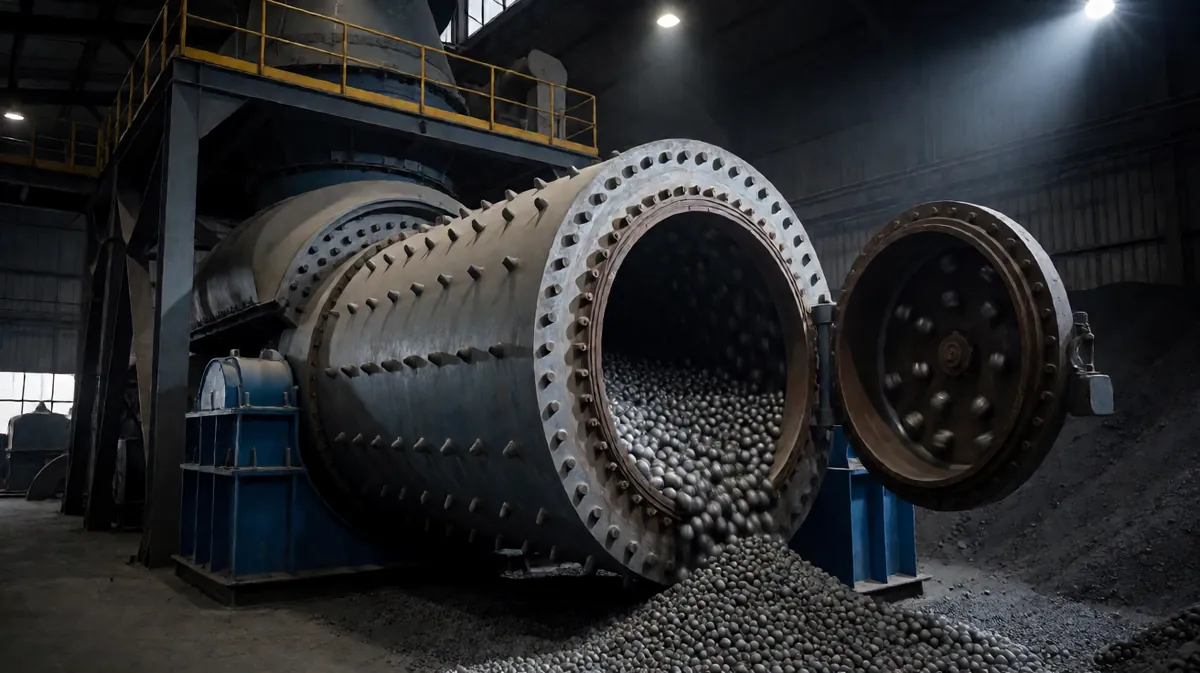
Grand Heavy wear castings — a material certificate per batch, matched to the milling duty
Selection proceeds in four steps: material first, then ball size, then charge grading, and finally filling degree.
| Dimension | Duty Condition | Recommended | Why |
|---|---|---|---|
| Material | Hard ore, high abrasiveness | High chrome cast | Hardness advantage shows directly in consumption |
| Material | Large ball size, high impact | Forged / tough high chrome | Breakage rate is the first control point |
| Material | Wet milling, aggressive slurry | Better corrosion resistance | Counters corrosion-abrasion synergy |
| Material | Non-metallic minerals, no iron pickup | Ceramic balls | Avoids iron contamination, but recalculate capacity |
| Ball size | Coarse feed (primary milling) | Increase large ball share | Only large balls break coarse particles; otherwise circulating load rises |
| Ball size | Fine feed (secondary or regrind) | Reduce ball size | Large balls over-grind in fine stages |
| Grading | Wide feed size distribution | Multi-size charge | A single size cannot handle both coarse and fine |
| Filling degree | Routine duty | Calibrate to mill manual and measured output | Excess filling wastes power and accelerates liner wear |
| Acceptance | Bulk purchasing | Sampling for hardness, breakage rate and consumption logs | Only these three together reveal true value |
Specific size ratios and filling degrees must be calculated from mill specification, feed size distribution and target fineness — follow the mill manual and on-site trial data. [To be added: recommended size grading and filling degree table] Consumption per ton should be tracked monthly. [To be added: grinding ball consumption logs]
| Buyer Type | Action |
|---|---|
| Budget limited | Medium or low chrome as the baseline; spend effort on grading optimization, which costs nothing and pays quickly |
| Life focused | High chrome or forged balls matched to duty, with consumption and breakage logs verified batch by batch |
| Corporate bulk | Lock grade, hardness range and maximum breakage rate, annual pricing with test reports |
The correct order is: set ball size and grading from feed size first, then set material from ore abrasiveness and milling mode, and finally verify with consumption per ton and breakage rate. Comparing only hardness or only unit price always shows up later as higher consumption or breakage. Foshan Grand Heavy Trading Co., Ltd. has built mining equipment and wear casting expertise for 40+ years, holds 20+ patents, partners with Central South University and Guangdong University of Technology, and is certified as a National High-Tech Enterprise [To be added: certificate number]. We serve CNBM, Conch Cement and clients across 6 overseas markets with 24-hour response from Guangzhou, Foshan and Changsha.
📞 Grinding Ball Selection, Charge Grading & Mill Accessories — Grand Heavy
40 Years of Wear Casting | 20+ Patents | Central South University Partnership | National High-Tech Enterprise
Trusted by CNBM & Conch Cement | 24-Hour Response from Guangzhou, Foshan, Changsha
Hotline: +86-0757-18144901190 | Email: zhouwenbin@fsgrandheavy.com
Website: www.fsgrandheavy.com
Grand Heavy — Material for the duty, grading for the feed, consumption finally makes sense!

Crusher Wear Parts Life Reference Table: Jaw Plates, Blow Bars, Hammers, Mantles and More

5 Common Cone Crusher Failures and How to Fix Them

Advantages of the Small Hydraulic Double-Roll Sand Making Machine

Jaw Plate Buying Guide: Material Identification, Price Traps and Replacement Cycles

Beyond Material Wear: What Other Factors Shorten the Service Life of Fixed Jaw Plates?

Jaw Crusher vs Impact Crusher: Which One to Choose? A 6-Factor Comparison


Room 3411, Building 1, Xinrui Plaza, No. 10 Lianing Avenue South, Dongping Community, Lecong Town, Shunde District, Foshan City (for office use only)
18144901190 (Miss Zhou )
zhouwenbin@fsgrandheavy.com

I. The information displayed on this website is provided by the website owner, who is responsible for the authenticity, accuracy, and legality of the content.
II. If the certificates displayed on this website are expired or invalid, visitors are welcome to notify us to replace them with valid certificates. (Contact information available on this website)
III. If the information displayed on this website infringes your copyright or other legal rights, or displays any content violating national laws, please contact us (Company: Foshan Damei Smart Manufacturing Trading Co., Ltd Phone: 18144901190 Email: zhouwenbin@fsgrandheavy.com). We will review and handle within 24 hours.
The New Advertising Law stipulates that no absolute or functional terms shall appear on any page. Our company supports the New Advertising Law. In order not to affect consumers' normal purchases, we have reviewed and modified the prominent areas of our pages. We hereby solemnly declare: All absolute and functional terms on our pages are invalid before this declaration and shall not be used as grounds for compensation.
For non-prominent areas and unchecked areas, we will gradually make improvements. However, manual review cannot guarantee 100% completeness. We do not accept or compromise on any form of compensation claims based on superlative terms or online fraud in the name of counterfeit detection. Please make way for genuine consumers, as rights protection is a two-way process. We hope new and old customers understand and support us, and contact customer service to help improve.
Pursuant to the Advertising Law and instructions from the Administration for Industry and Commerce, we specially remind you that the product titles on this website are set purely for operational and technical traffic purposes and do not constitute product efficacy claims. Please do not take them out of context. Additionally, in accordance with Article 15 of the Consumer Rights Protection Law of the People's Republic of China regarding the authenticity of product promotion, as well as the Advertising Law, the Management Standards for Disinfection Product Labels and Instructions, the Regulations on Supervision and Administration of Medical Devices, and other relevant laws and regulations.
All products sold are officially authorized. The actual formula (structure) of the products is consistent with the product packaging or instructions. Page titles are keywords used solely to match buyer search habits and do not represent the actual efficacy and characteristics of the products. The text, images, and video information on the page are solely for website optimization purposes. The actual ingredients and efficacy of the products are subject to the product packaging or instructions. Please be informed!


